A minimal, pure ARM-native cryptocurrency miner.
No x86 translation layer — Verus, Monero, scrypt and SHA256d written directly in ARM intrinsics and AArch64 assembly.
One ~557 KB binary. Linux SBCs · Termux · Android APK. Open source, GPL-3.0.
Built for ARM. Not ported to it.
What one binary does on every ARMv8 device.
Pure ARM-native
No SSE-to-NEON translation layer; hot paths are ARM intrinsics and hand-tuned AArch64 assembly using PMULL, AES and SHA2 hardware crypto.
Four algorithms
VerusHash 2.2 (Verus), RandomX (Monero), scrypt (Litecoin + Dogecoin merged), SHA256d (Bitcoin).
Per-core runtime optimization
Detects big.LITTLE topology at startup and picks the fastest kernel per core; one binary is optimal on every device.
Hotplug-resilient core pinning
Pins reconcile continuously; the miner re-adopts cores Android parks and wakes instead of losing them.
Self-verifying
Every optimized kernel (including the assembly) is cross-checked against a reference implementation at startup; the miner refuses to run on mismatch.
Full stratum
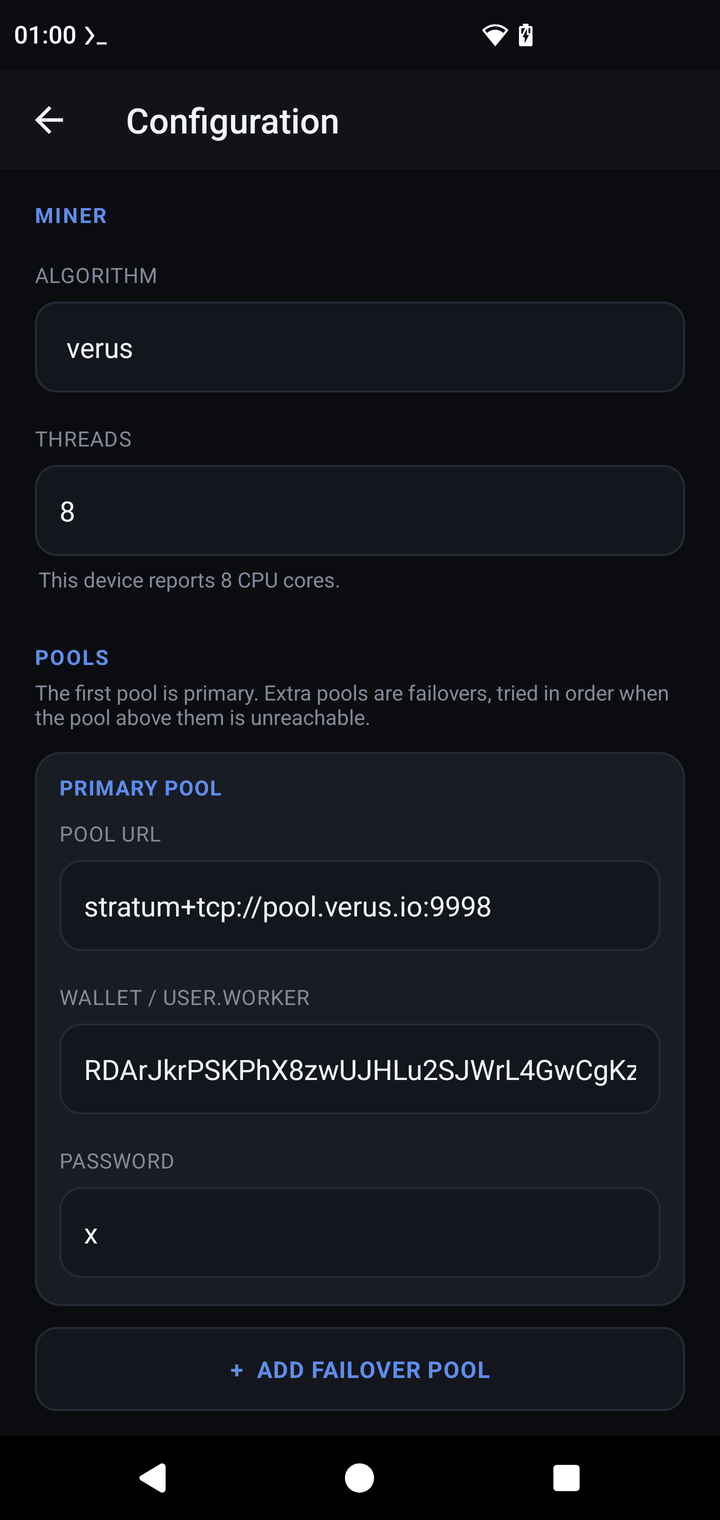
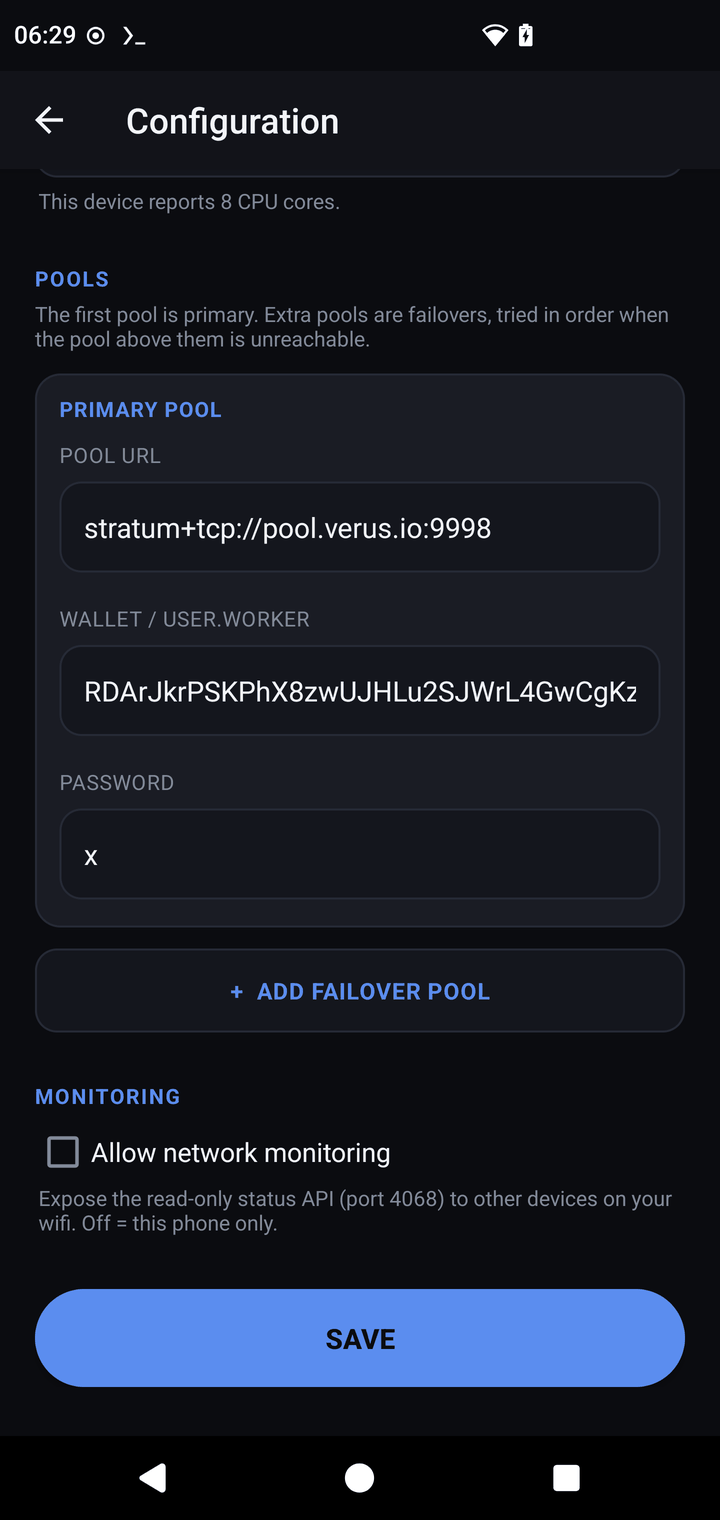
Multi-pool failover, TLS (stratum+ssl://), Verus/standard/Monero dialects, ccminer-compatible CLI, config format, and monitoring API.
Tiny footprint
Single ~557 KB binary, two runtime libraries (libcurl, libjansson).
Android APK
The same native miner in a one-tap app: per-algo profiles, pool failover, live dashboard, in-app log viewer.
Measured, not projected.
Measured on RK3588 (4×Cortex-A55 + 4×Cortex-A76). Real hashrate depends on cooling, governor, and SoC.
| Algorithm | A76 single core | 8 threads |
|---|---|---|
| VERUSVerusHash 2.2 | ~1.44 MH/s | ~7.5 MH/s |
| RANDOMXMonero | ~160 H/s | ~690 H/s |
| SCRYPTN=1024, LTC+DOGE | ~4.8 kH/s | ~25.9 kH/s |
| SHA256DBitcoin | ~16.3 MH/s | ~90 MH/s |
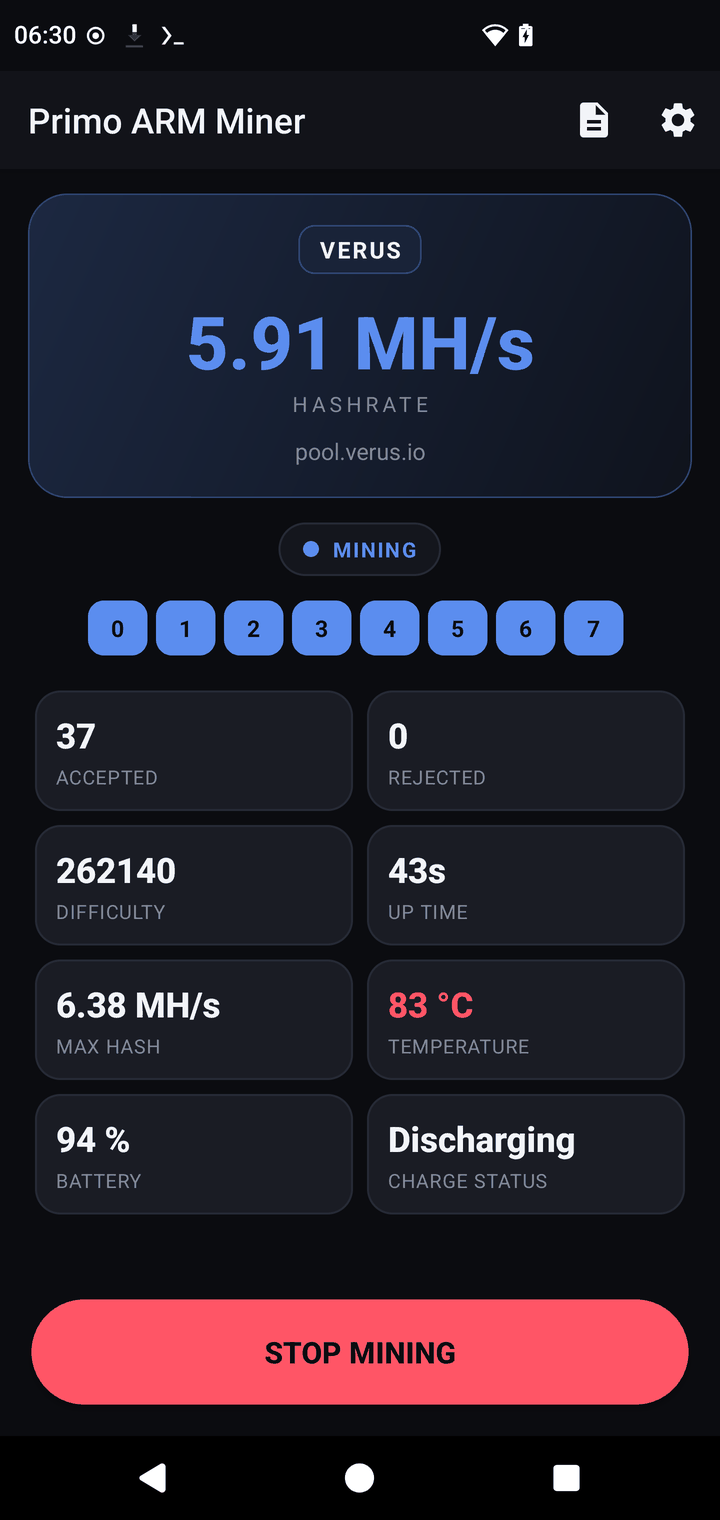
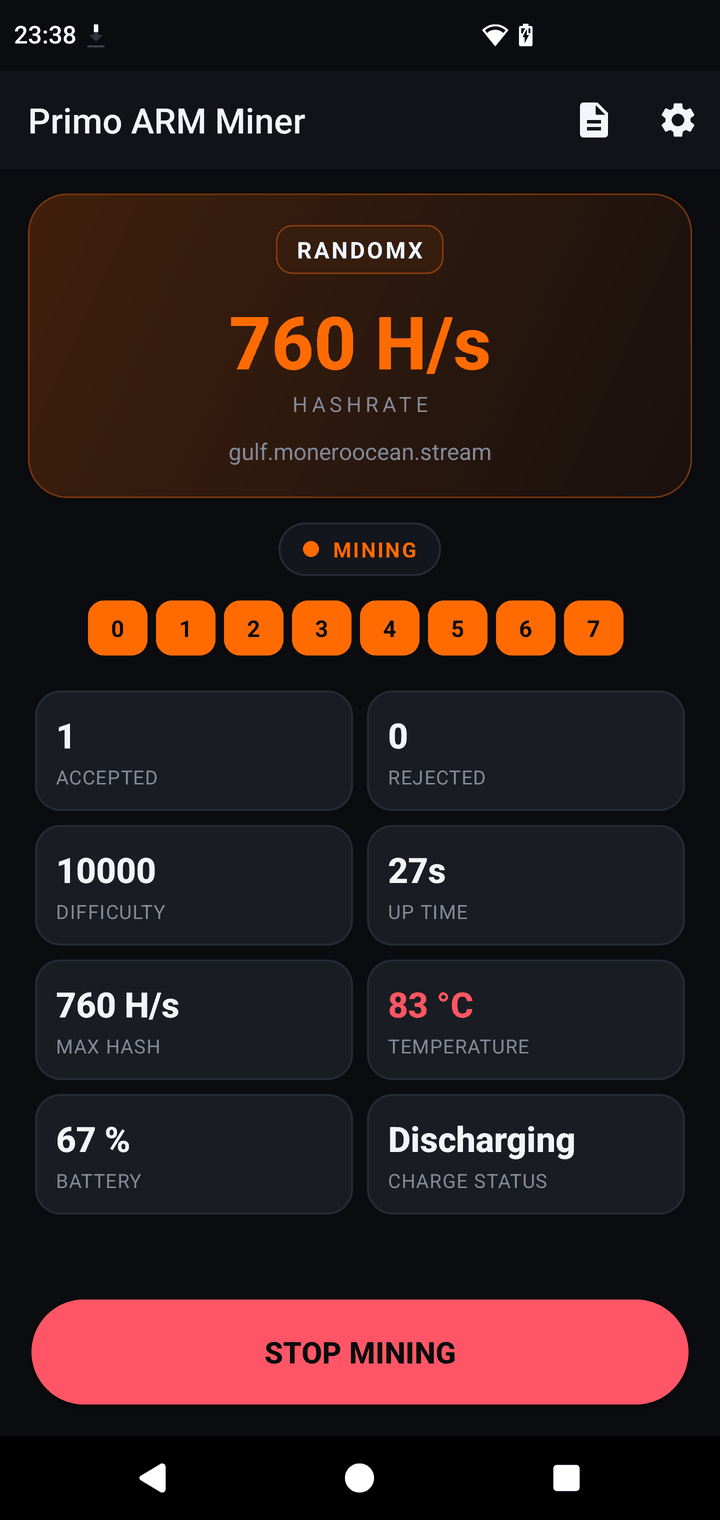
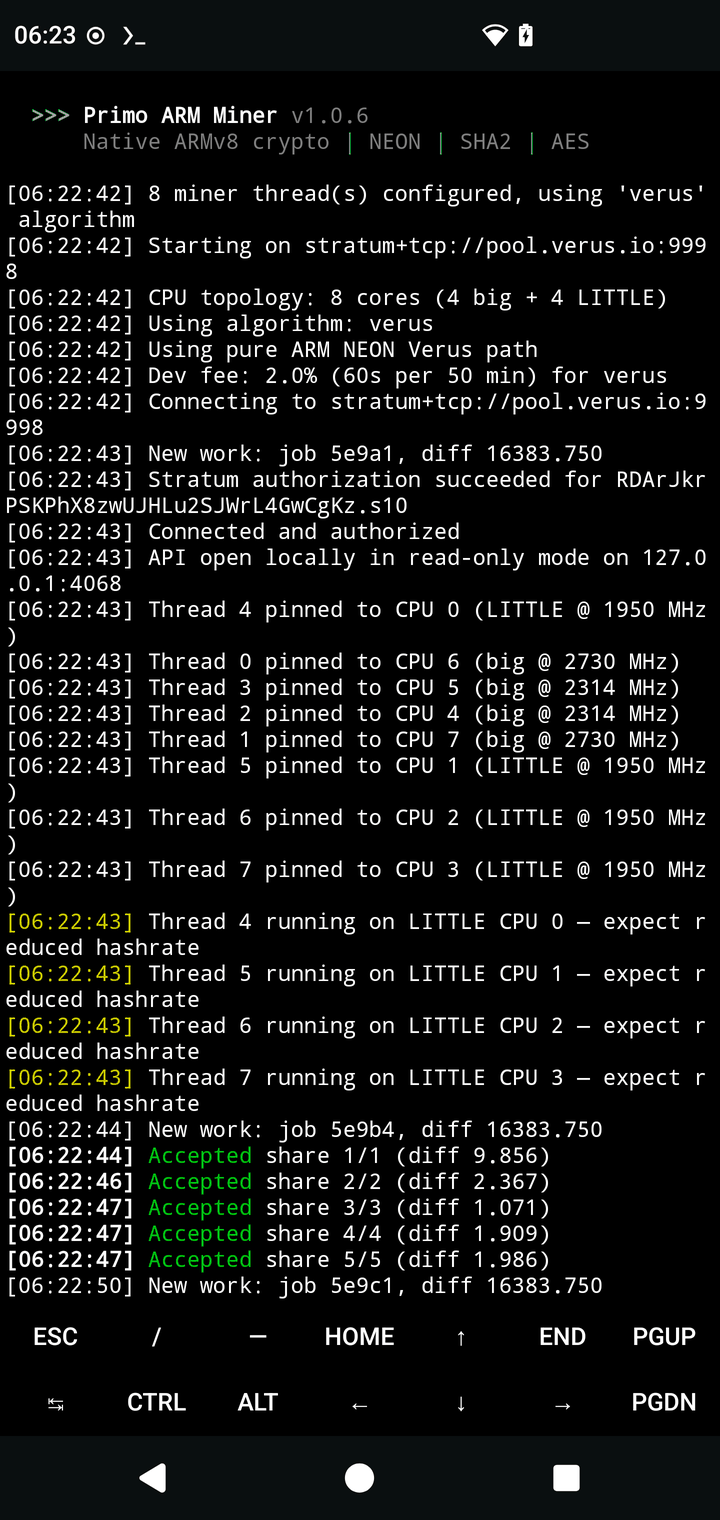
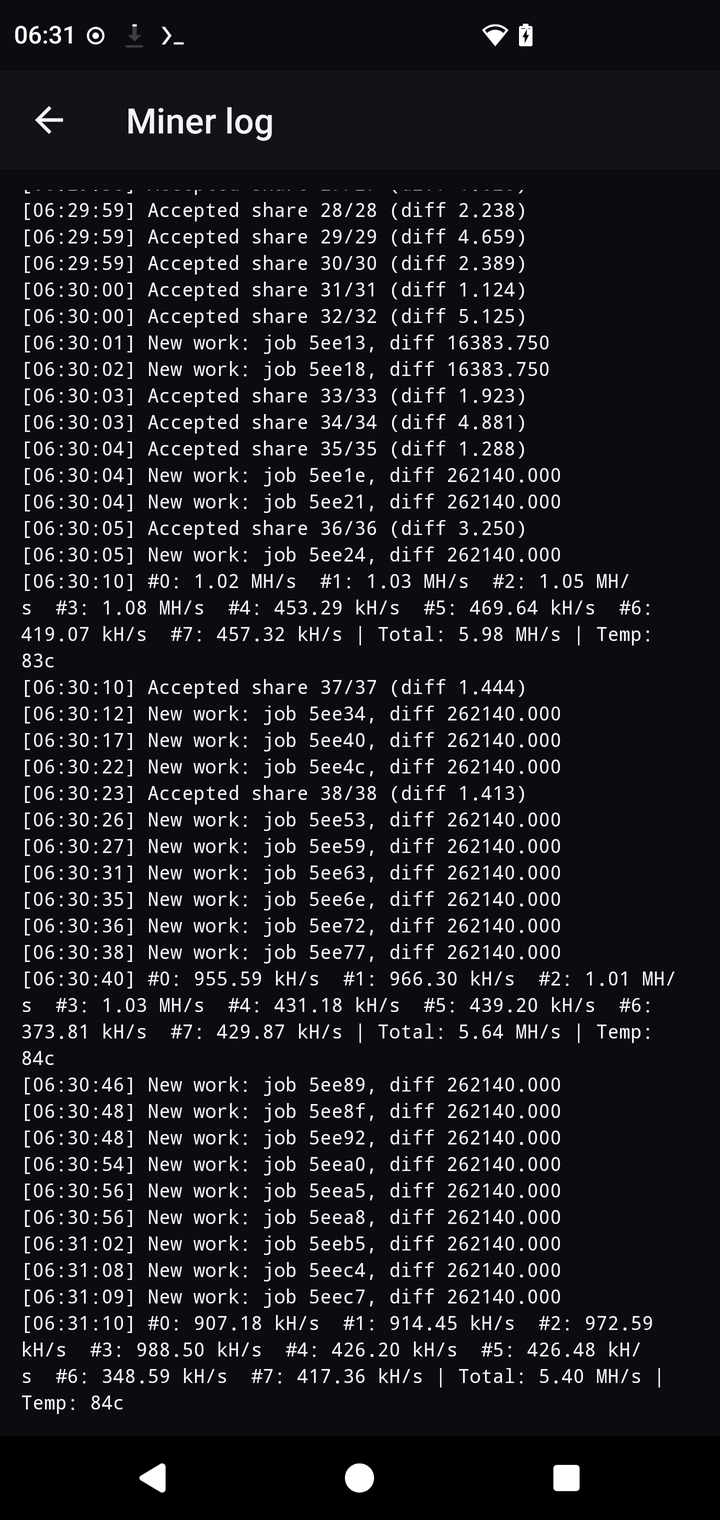
Galaxy S10+ (Exynos 9820): ~5.5–5.9 MH/s Verus, ~700 H/s RandomX across 8 threads.
RandomX fast mode needs ~2.5 GiB free RAM (automatic light-mode fallback on low-RAM devices) and runs hotter than the other algorithms.
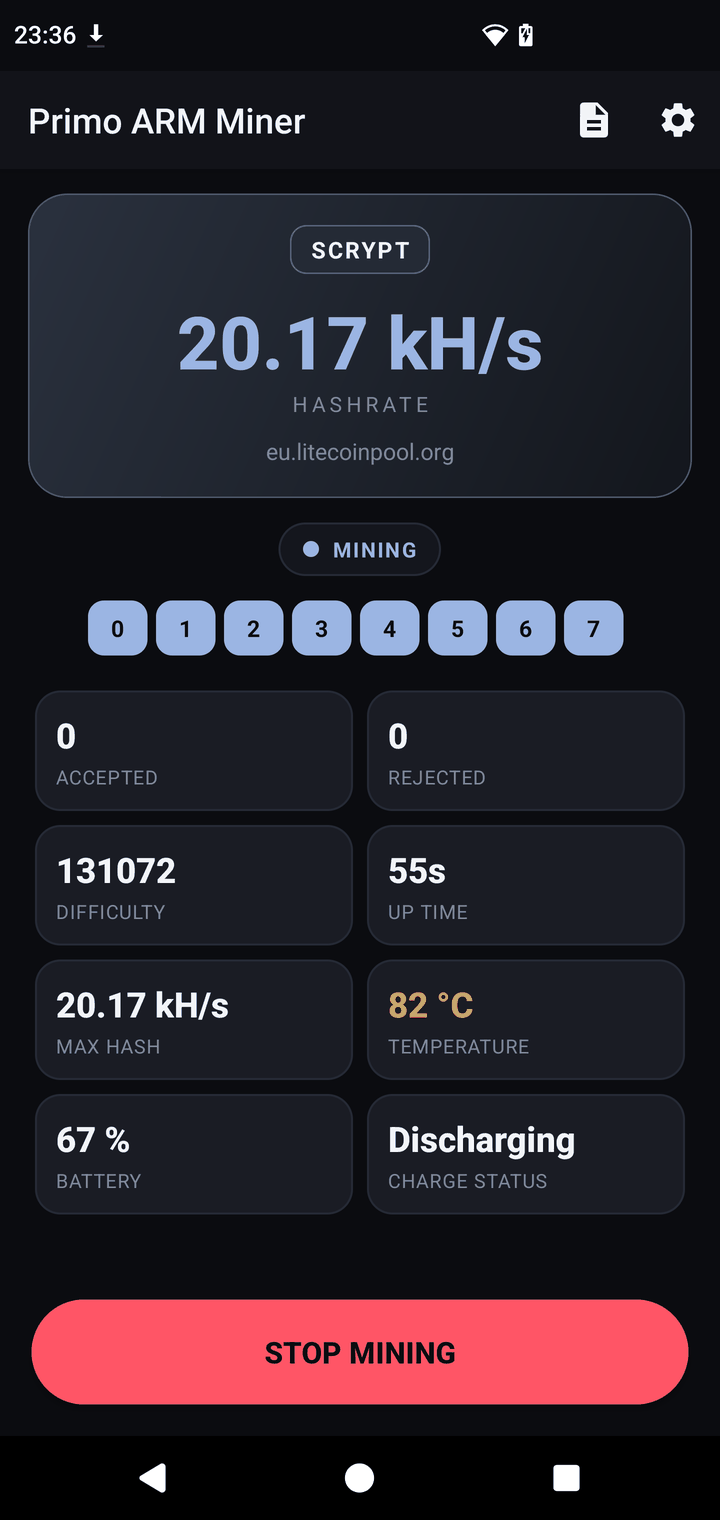
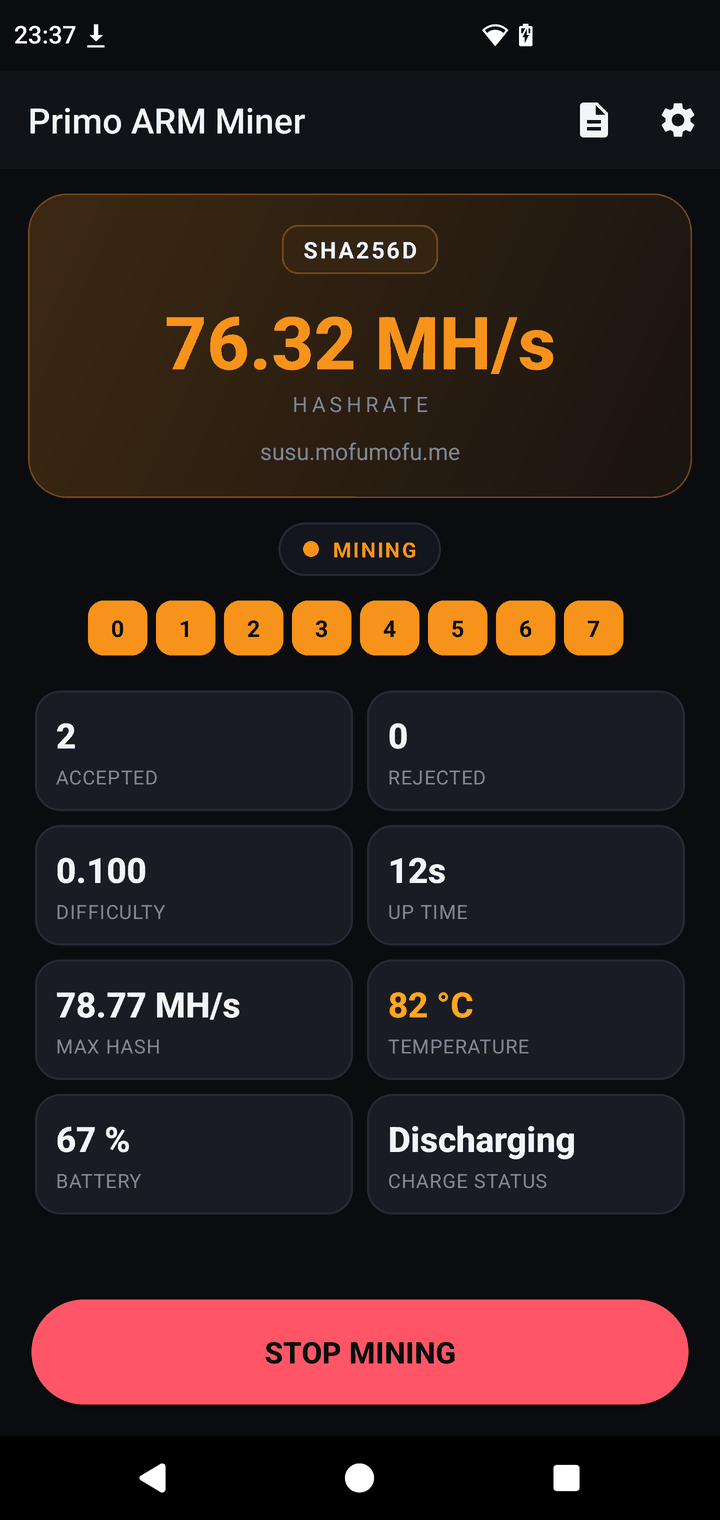
The app, as it runs.
Real captures from a Galaxy S10+ — no mockups.
Download
Pick your platform. Verify the SHA-256 before running.
primo-arm-miner to your PATH. POSIX sh; prefer not to pipe to a shell? Use the platform tarballs below and verify them yourself.
Linux arm64 (SBC)
Static tarball for Raspberry Pi-class boards and up.
Requires: 64-bit ARMv8 CPU, 64-bit OS, libcurl + libjansson.
SHA-256: SHA256SUMS
Android Termux
Same binary, built against Termux libs. Installed by the one-liner above.
Requires: Termux (F-Droid build recommended), arm64 device.
SHA-256: SHA256SUMS
Android APK (sideload)
One-tap app: profiles per algorithm, failover pools, live dashboard, log viewer.
Requires: Android 7+, arm64.
Not on the Play Store (Google bans mining apps). Sideload the APK: enable "install unknown apps", tap the file.
Permissions: network · foreground-service notification · keep-awake · ignore battery optimization. Never: storage, contacts, SMS, location, camera, mic.
SHA-256: SHA256SUMS
Verify a manual download — the one-line installer does this for you automatically:
$ curl -fsSLO https://primolab.dev/dl/SHA256SUMS
$ sha256sum -c SHA256SUMS --ignore-missing
Nothing hidden.
A miner you can't audit is a miner you shouldn't run.
Dev fee, disclosed
One 60-second slice of mining per cycle on the developer's pool:
- Verus — 2% (60 s per 50 min)
- RandomX / scrypt / SHA256d — 1% (60 s per 100 min)
If the dev pool is unreachable your mining is never interrupted — the slice is skipped. It's GPL: forks may remove it. The fee logs itself in the console.
Open source
GPL-3.0-or-later. Full provenance of every optimized kernel is documented in-repo (PROVENANCE.md, NOTICE). Build it yourself and compare.
Verified at startup
Self-tests gate mining at startup — every optimized kernel is checked against a reference implementation. The monitoring API is read-only.
Donations
Donations fund ARMv9 test hardware (SVE2 boards and phones) for the next generation of optimizations.
RDArJkrPSKPhX8zwUJHLu2SJWrL4GwCgKz
42oukEEbeW8ippUDnUrexGS53QZ5gi28ELofq8KPgEoya1yghHACvNwbr9fJHGQWJUPz16cyJeFXcEexLuy7pBcdBzrzxvZ
ltc1qguj48xprktyeqm4dqrje5cr7f8g76e0mvrdjh6
15nR6PuUkjTyjv9dnkYd2GbjbgiMxs4dLi